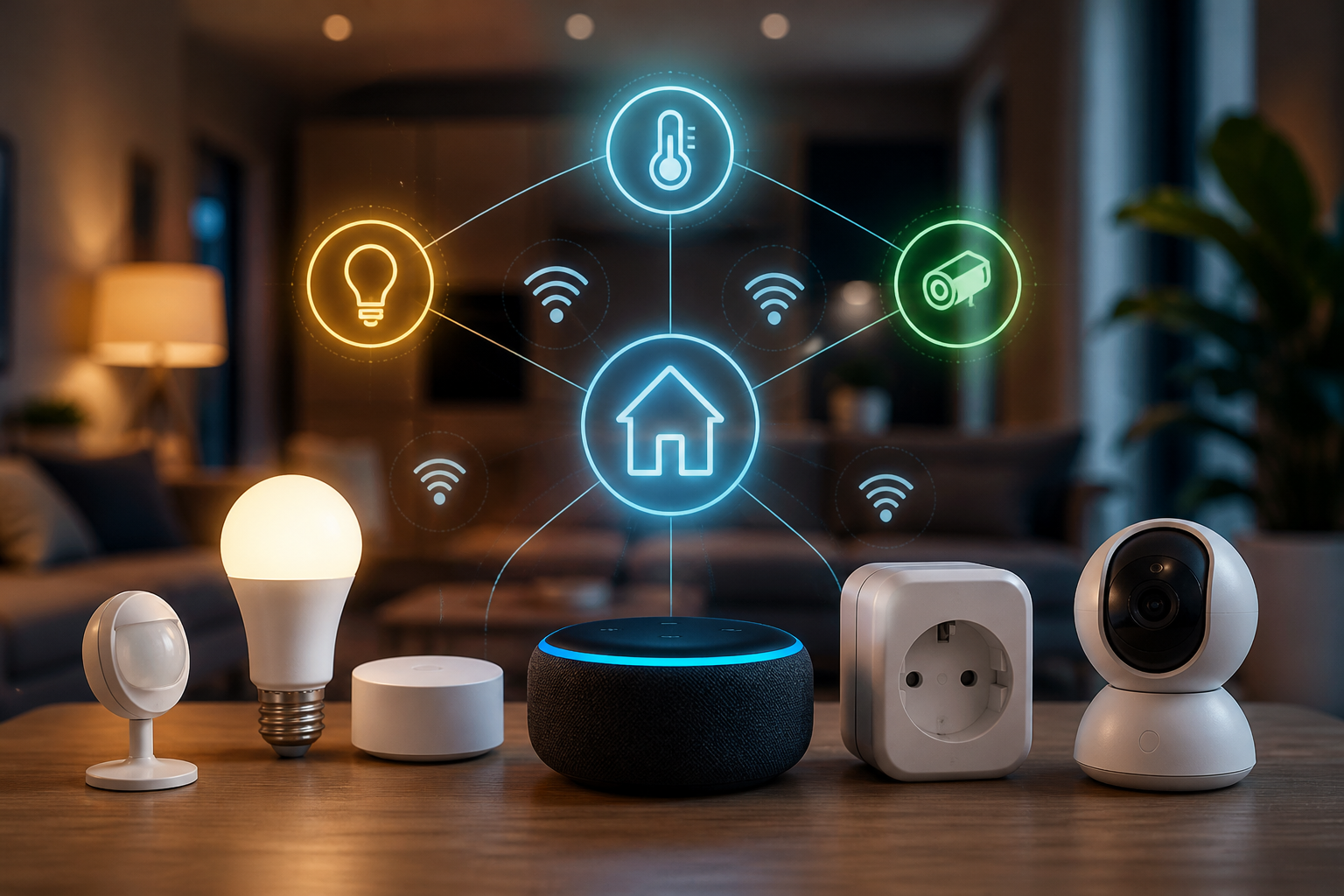
In the era of home automation, choosing the right communication protocol can be key to optimizing connectivity and efficiency in your smart home. Two of the most well-known protocols, Zigbee and Z-Wave, have been cornerstones in the residential automation ecosystem. However, with the arrival of Matter, a new standard promising unity and compatibility, users find themselves at a crossroads. In this article, we will delve deep into the characteristics, advantages, and applications of Zigbee, Z-Wave, and Matter in the context of local home automation.
Zigbee: Connectivity and Energy Efficiency
Zigbee is a low-power wireless communication protocol designed for home automation applications. It operates in the 2.4 GHz band, allowing communication between devices through a mesh network. This topology enables nodes to communicate directly with each other, improving coverage and reducing latency. One of its biggest advantages is energy efficiency; Zigbee devices can operate on batteries for several years. Moreover, its modulation and use of reduced bandwidth make it less susceptible to interference from other devices. However, deployment requires a hub, such as Home Assistant, to centralize communications for managing multiple devices from various manufacturers.
Z-Wave: Stability and Versatility
Z-Wave is another popular protocol designed specifically for home automation and local home automation. Unlike Zigbee, Z-Wave operates primarily at lower frequencies (sub-GHz), allowing for longer communication ranges and greater resistance to interference. One of its distinguishing features is interoperability among devices from different manufacturers, which is essential for a cohesive smart home ecosystem. Z-Wave features a mesh network similar to Zigbee, but each node can act as a repeater, further enhancing communication stability. However, despite these advantages, Z-Wave devices tend to be slightly more expensive due to their specific design and regulations. Like Zigbee, Z-Wave integration in your home often occurs through hubs such as Home Assistant.
Matter: The Universal Solution
Matter is the new standard aiming to unify communication in smart home devices. Developed by a consortium of major tech companies, this protocol strives to eliminate compatibility barriers that have existed between Zigbee and Z-Wave. Matter operates over standard network protocols such as Wi-Fi and Ethernet, meaning it does not require a dedicated hub for operation. This results in simpler installation and a more accessible ecosystem for users. Furthermore, its security focus ensures that user privacy remains intact. The advent of Matter promises not only to facilitate device connectivity but also to expand the range of options in local home automation. Integrations with platforms like Home Assistant are underway, meaning it will soon be easier than ever to bring all your devices together.
Common Mistakes and Best Practices
When setting up a home automation system, avoiding common mistakes is crucial. Firstly, ensure device compatibility before purchasing. A frequent error is choosing devices from different protocols without adequately planning for their integration. Additionally, do not underestimate the importance of range and network type; make sure your hub or router can handle multiple devices throughout the house. Lastly, consider security; be sure that your devices are updated and use encryption to protect your data. This is especially relevant in the context of Matter, where security is one of its cornerstones. Planning and research are key tools to ensure a positive experience in your local home automation.
Conclusion
The evolution of communication protocols in home automation, like Zigbee, Z-Wave, and Matter, is reshaping home automation. To maximize your experience, consider your specific needs and device compatibility. Choosing the right protocol will allow you to build an efficient and connected ecosystem. The next time you think about a device for your smart home, remember to research how it integrates with your current local home automation system.
Keywords: Zigbee, Z-Wave, Matter, domótica local, Home Assistant
Views: 6