Did you know that a simple voltage spike can irreversibly damage microcontrollers in your IoT projects? This can happen without warning, and often the damage is irreparable. Fortunately, using optical isolation and relays can make all the difference, protecting your vital circuits and ensuring the longevity of your devices. In this article, we will explore how opto-isolators and relays are essential for safeguarding the integrity of microcontrollers, especially the popular ESP32, a favorite in the IoT world.
What is optical isolation and why is it important?
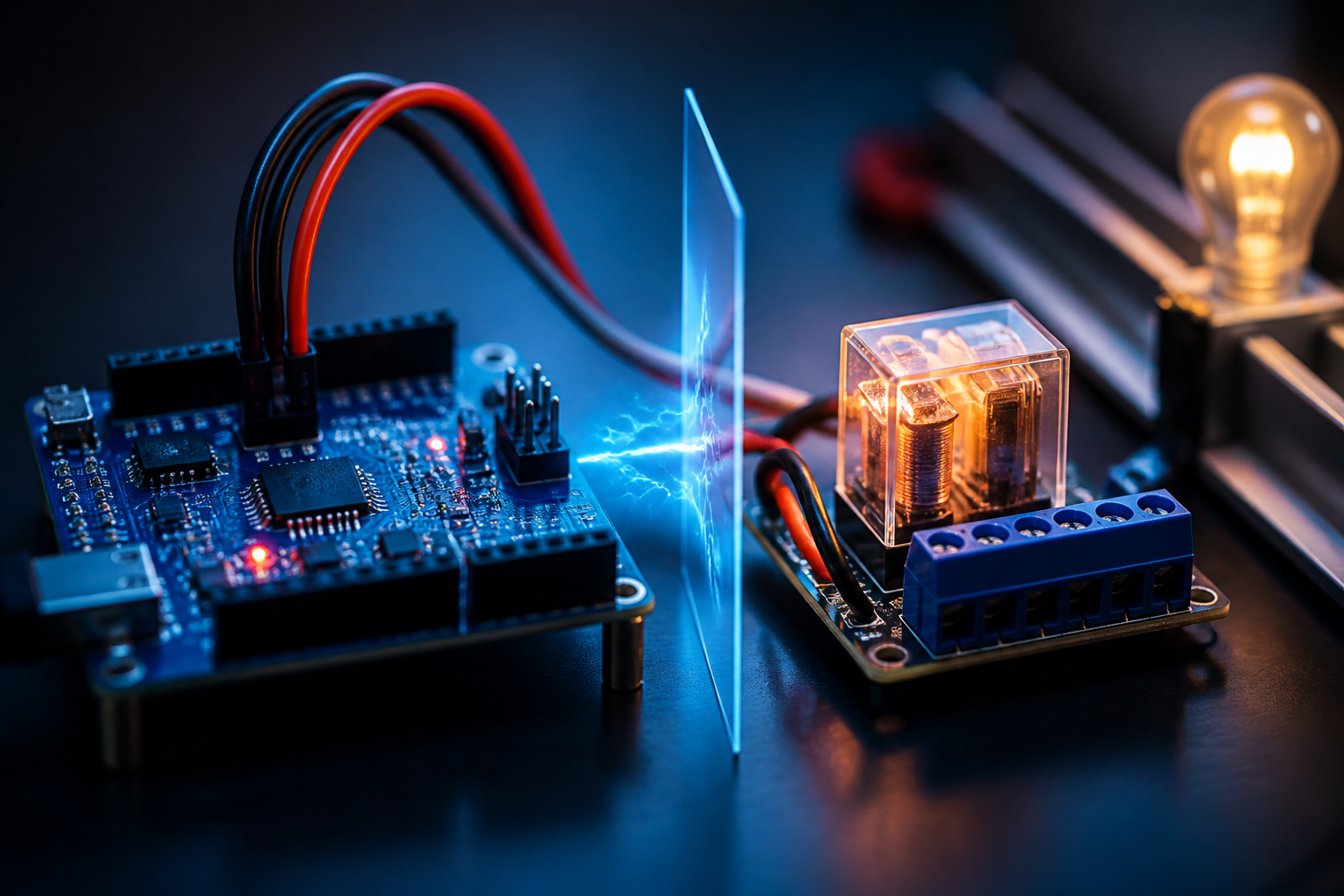
Optical isolation is a technique that uses opto-isolators to transmit signals while maintaining an electrically isolated potential between the emitter and receiver. This separation is crucial in applications where voltage spikes can occur, such as in industrial environments. The operation is based on a device that converts an electrical signal into light and then turns it back into an electrical signal, thereby protecting circuits from undesirable voltages. In IoT projects, using opto-isolators to connect sensitive components like the ESP32 to high-voltage equipment is essential.
Inductance calculation and its relevance
Inductance, the property of an electrical circuit that opposes changes in current, becomes critical when using relays. A relay is a switch that can open or close electrical circuits via an electromagnet. However, when voltage is suddenly cut off, the magnetic field collapses, generating voltage spikes that can damage other components. This is where optical isolation becomes an ally. Not only does it allow for safe operation, but its implementation also helps mitigate the effects of relay inductance, protecting the ESP32 from damage.
Practical guide to implementing optical isolation
To correctly implement optical isolation in your project, follow this step-by-step guide. First, choose the appropriate opto-isolator, ensuring that its specifications align with your project requirements. Then, connect its emitter to the signal you want to isolate. On the other side, connect the receiver to the output circuit, such as the ESP32 pin. This process is relatively simple, but must be done carefully to avoid short circuits. Once installed, make sure to test the system under different conditions to verify its effectiveness in protecting against voltage spikes.
Common mistakes when using relays and opto-isolators
One of the biggest mistakes when working with opto-isolators and relays is underestimating the importance of correctly selecting components. Not all opto-isolators are equal; you must consider speed, current, and voltage ratings. Another common mistake is poor circuit design. Be sure to include flyback diodes on the relay side to prevent damage from voltage spikes. A lack of a good design plan can also result in intermittent failures. Learning about these best practices is crucial to avoid replacement costs and keep your IoT projects running smoothly.
Conclusion and practical advice
The use of opto-isolators and relays is essential for protecting microcontrollers like the ESP32 in IoT projects. With proper optical isolation, you can achieve a much safer and more durable environment for your devices. Make sure to understand inductance and its influence on circuits, as well as to follow best practices to ensure your project is successful. Don’t compromise the safety of your systems; research and select the right components ahead of time!
Keywords: Optoacopladores, inductancia, protección de circuitos, ESP32
Views: 8