Why are some action mangas easier to read than others? The answer lies in the reading flow, a technique that effectively guides the reader’s gaze throughout the story when applied correctly. Through careful visual composition, artists can create an immersive experience that keeps readers engaged. In this article, we will explore the action lines, storyboards, and panel distribution that make these mangas a visual and narrative delight.
The Importance of Reading Flow
Reading flow is fundamental to reader comprehension. This flow refers to how the eyes move from one panel to another and how the composition influences that experience. Good reading flow intuitively guides readers, facilitating their absorption of content. This effect is achieved through various techniques, such as using action lines that direct the gaze. These lines act like invisible arrows, leading the reader through the key moments of the story without disrupting the narrative. A cohesive flow not only captures the interest but also aids in maintaining continuity in action and dramatic tension during a fight or adventure sequence.
Using Effective Action Lines
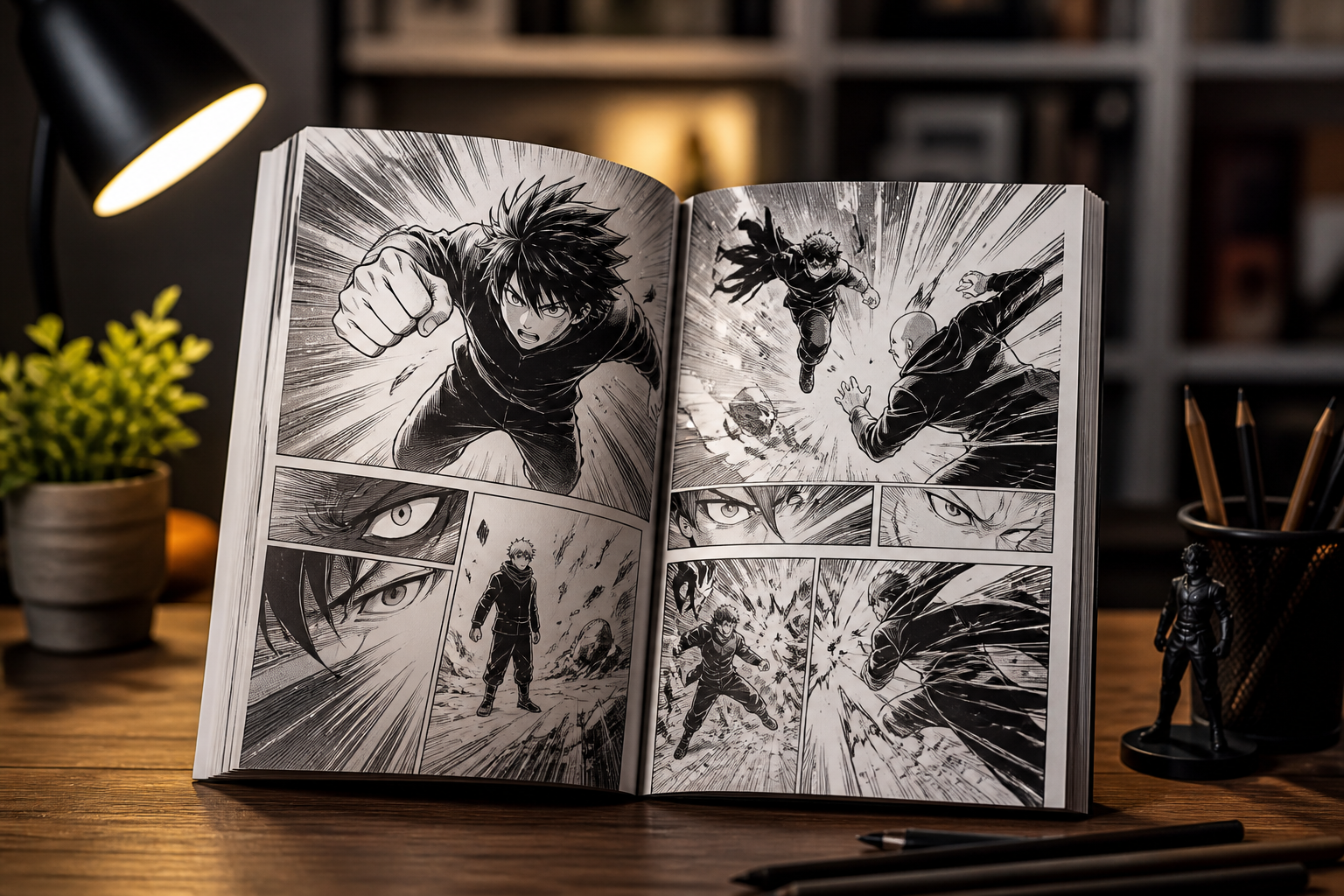
Action lines are one of the most powerful elements in the visual narrative of a manga. These lines can be explicit, like drawn motion lines in a fight, or implicit, like the direction characters are looking. Using effective action lines not only helps establish the direction in which the eyes should move but can also intensify the scene’s emotion. For instance, in a fight, directing the action line towards an impending punch can evoke an emotional impact on the reader, making them feel they are in the middle of the action. Action lines can be designed using various graphic techniques, such as perspective and framing, to enhance the dynamism of the scene.
Storyboards and Their Fundamental Role
The storyboard is a crucial tool in creating action mangas. It acts as a map that guides the layout of panels and the sequence of events. A well-designed storyboard allows the reading flow to remain natural, optimizing both time and narrative space. Each panel serves as a frame in a movie, and the storyboard defines how these frames interconnect. The panel distribution should be strategic: faster panels can be smaller and tighter, while those requiring more attention can be larger and more spacious. This technique helps vary the pacing within the narrative, creating a contrast that can lead to moments of great tension or comic relief.
Panel Distribution: Planning and Execution
Panel distribution also plays an essential role in the reading flow. Each panel should serve a purpose and contribute to the story’s advancement. Planning how and where panels are placed can drastically affect how the story is perceived. The best mangas use a mix of large, small panels, and different orientations to maintain visual interest. This variation not only avoids monotony but also tricks the reader’s mind, making it difficult to predict what will come next. Through this technique, anticipation and excitement are built—vital aspects in an action manga.
Conclusion: The Synergy of Art and Narrative
In conclusion, visual composition and framing are essential for ensuring an effective reading flow in action mangas. By leveraging action lines, storyboards, and panel distribution, creators can turn a simple story into an unforgettable visual experience. If you’re interested in creating your own manga, remember that every panel counts. Plan, execute, and never underestimate the power of framing.
Keywords: Flujo de lectura, líneas de acción, storyboard, distribución de viñetas
Views: 3